
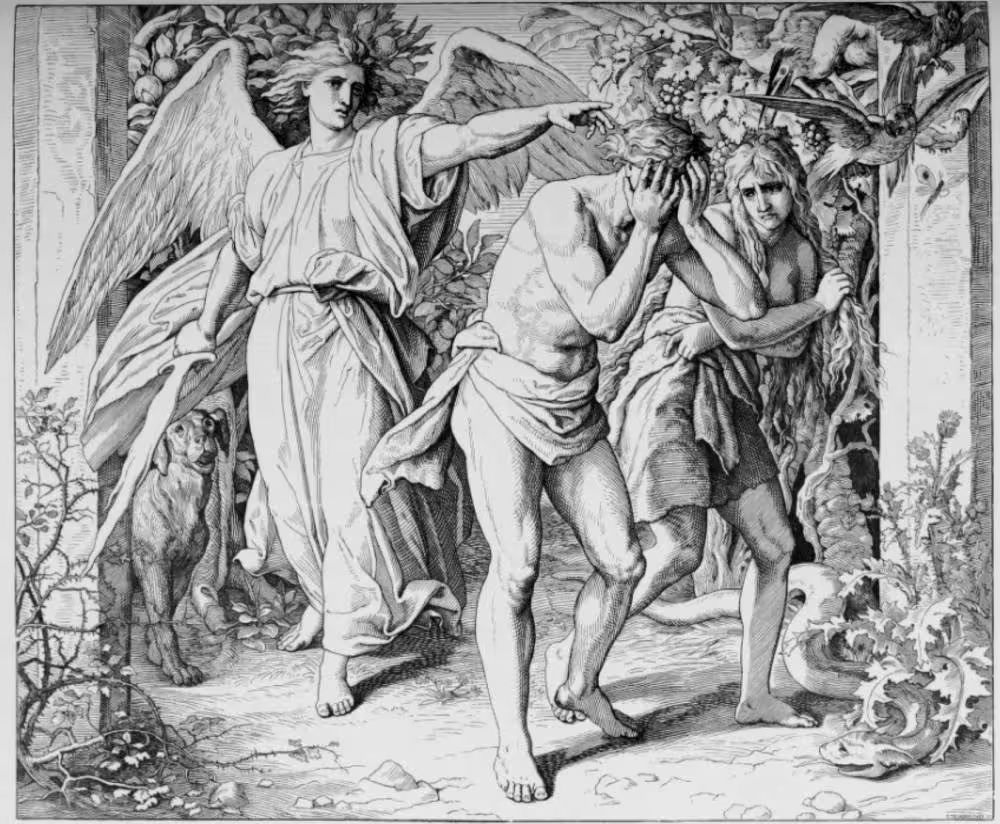
The Fall of Man represents the critical, defining crisis of the biblical narrative. It marks the historical and structural transition from the pristine Shalom of creation into a physical and spiritual reality fractured by entry of sin, entropy, and death. In systematic theology, this specific field of inquiry is designated as hamartiology (the formal study of the nature, origin, and transmission of sin).
Understanding the precise structural mechanics of the Fall is not an isolated historical or literary exercise; it is the absolute prerequisite for comprehending the holy character of God as a Just Judge and the logical necessity of the subsequent covenants in the Bible.
From a free-will, Provisionist perspective, the Fall must be analyzed through the lens of libertarian free will. Moral evil was not a hidden, divinely decreed necessity designed to orchestrate cosmic drama, nor did God causally determine the failure of humanity. Instead, sin entered the cosmos through the uncoerced, volitional choice of free moral agents who were intentionally gifted with the capacity for authentic relationship, moral responsibility, and contrarian choice (the power to choose otherwise).
The Origin of Sin: The Temptation in the Garden
The historical account of the Fall unfolds in Genesis 3, where the introduction of the Serpent establishes a structural inversion of the created cosmic order. In the original design of creation, the human agent sat under divine authority to govern the material world. The temptation reversed this hierarchy, tempting the creature to usurp the position of the Sovereign Creator.
1. The Tree as a Volitional Boundary
God placed the Tree of the Knowledge of Good and Evil at the geographic center of the Garden of Eden not as an arbitrary stumbling block, but as a structural necessity for volitional validation. Love, obedience, and relational loyalty cannot be mechanical defaults; for virtue to exist authentically, the real possibility of rejection and disobedience must be operational. The negative command (“you shall not eat”) functioned as a clear boundary marker reinforcing the essential Creator-creature distinction.
2. The Threefold Typology of Temptation
The psychological strategy deployed by the tempter systematically targeted every dimension of the human faculty, establishing a historical template of temptation that mirrors the warning in 1 John 2:16:
  Genesis 3 Archetype                   1 John 2:16 Typology
  ├── "Good for food"       =======>    └── Lust of the Flesh (Appetite)
  ├── "Pleasant to the eyes" =======>    └── Lust of the Eyes (Aesthetics)
  └── "To make one wise"     =======>    └── Pride of Life (Ambition)
By presenting the boundary marker as a restriction on human potential rather than a protection of human flourishing, the tempter manipulated human desire, prompting Eve and Adam to prioritize subjective autonomy over objective divine truth.
The Mechanics of the Fall: What Went Wrong?
When humanity crossed the volitional line and consumed the fruit, the result was not a minor moral lapse, but a catastrophic systemic fracture that instantly corrupted three primary relational spheres:
- Theological Alienation (Spiritual Death): The immediate response to transgression was the onset of guilt and fear, causing Adam and Eve to physically hide themselves from the presence of God. This denotes immediate spiritual alienation—the cutting off of the human soul (nephesh) from its vital spiritual source, the holy nature of God.
- Sociological Alienation (The Relational Fracture): Human harmony was instantly shattered by defensive self-preservation. When confronted by the Creator, Adam immediately engaged in defensive blame shifting—faulting both the woman and the God who provided her (“The woman whom you gave to be with me…”), while Eve shifted blame to the Serpent, showing the entry of relational exploitation.
- Ecological Alienation (Physical Entropy): The judicial consequences of the Fall rippled directly into the physical order (“Cursed is the ground because of you”). Creation was subjected to futility and biological entropy, introducing decay, physical suffering, and inevitable somatic death into the material world.
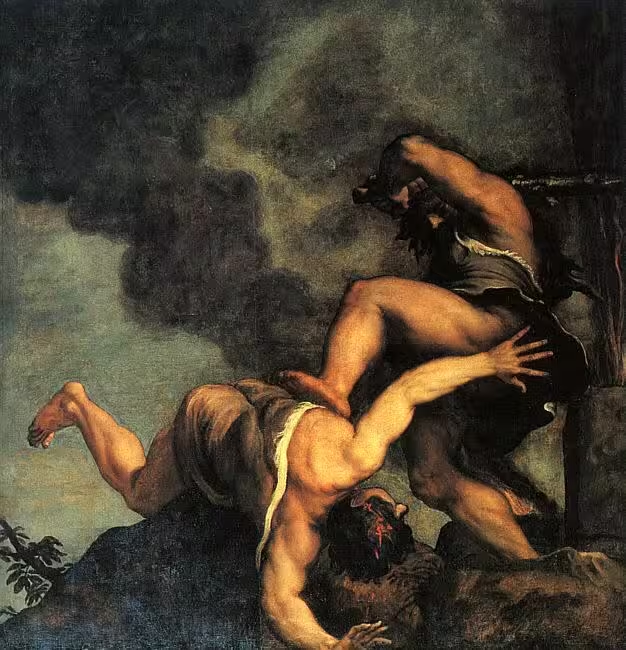
Defining Original Sin: Mapping the Scholarly Models
The historical transmission of Adam’s sin to his descendants is one of the most intensely debated subjects in biblical scholarship. Theologies generally divide into three structural interpretive models:
| Theological View | Mechanism of Transmission | Judicial Status of Descendants | Moral Capacity of Fallen Man |
| Federal Headship | Legal Imputation | Born with Adam’s Legal Guilt and a broken nature. | Spiritually dead; lacks any capacity to cooperate with grace (Total Inability). |
| Realist / Seminal | Biological Transmission | Born inherently Guilty because all humanity was physically present in Adam. | Human nature corrupted at its root; unable to choose good unassisted. |
| Provisionist / Relational | Inherited Physical Frailty & Propensity | Inherit Adam’s Consequences (Mortality and Fleshly Propensity), but not his personal guilt. | Marred, yet intact Imago Dei; universally enabled by Prevenient Grace to respond to the Gospel. |
The Provisionist Distinction
While we fully recognize that the corrupted nature—traditionally designated as the flesh—is passed down generationally from Adam, our framework maintains that individual moral agents are held judicially accountable exclusively for their own personal, volitional acts of transgression.
Human beings inherit a dying physical body and a strong propensity toward self-centeredness, but they do not bear the judicial guilt of Adam’s personal historical act. This distinction vitalizes the absolute justice of God, confirming that condemnation is the result of personal rebellion rather than a biological trap set before birth.
The Philology of the Fracture: Structural Vocabulary of Sin
To comprehend the full scope of the Fall of Man, biblical scholars evaluate the specific terms used in the original languages of the Canon. Each word isolates a different facet of the moral breakdown:
- Ḥāṭā’ (חָטָא) / Hamartia (ἁμαρτία): The primary Hebrew and Greek terms, literally meaning “to miss the mark” or “to wander from the correct path.” This denotes a structural failure of a moral agent to align their behavior with the absolute standard set by the Creator’s design.
- Peša‘ (פֶּשַׁע) / Parabasis (παράβασις): Meaning “transgression” or “rebellion.” This is a strict legal and covenantal term denoting the deliberate act of stepping over an established line. It implies a conscious, volitional violation of a known legal boundary.
- ‘Āwōn (עָוֹן) / Anomia (ἀνομία): Meaning “iniquity” or “lawlessness.” This refers to an internal distortion or crookedness of character—the structural bending of the human affections inward toward self-worship rather than upward toward God.
Total Depravity vs. Total Inability
A critical boundary in systematic theology involves parsing how the Fall impacted human capability:
- The Reality of Total Depravity: Biblical scholarship correctly asserts that the Fall was comprehensive; sin has corrupted every facet of the human composition—the intellect, the emotions, the physical body, and the functions of the human will. No dimension of the human person remains completely pristine or untouched by the effects of sin.
- The Correction of Total Inability: Although human nature is totally depraved, the Provisionist framework rejects the deterministic notion of Total Inability (the idea that fallen man is structurally incapacitated from even hearing, understanding, or responding to the universal offer of the gospel). The Imago Dei, though severely marred and distorted by the Fall, was not completely obliterated. Through the universal deployment of Prevenient Grace, the Holy Spirit provides an objective enablement that lifts the spiritual paralysis of the Fall, restoring the human capacity to either volitionally yield to or actively resist the drawing power of God.
The Protoevangelium: First Light of the Rescue Plan
Even as God executed judicial judgment in the Garden of Eden, pronouncing specific curses upon the participants, He immediately provided the foundational prophetic blueprint for cosmic redemption. Genesis 3:15 is recognized in academic scholarship as the Protoevangelium—the literal “First Gospel”:
“I will put enmity between you and the woman, and between your offspring and her offspring; he shall bruise your head, and you shall bruise his heel.”
The Entrance of Sin (Genesis 3:6) ---> The Prophetic Interception (Genesis 3:15) ---> The Victorious Execution (The Cross)
This majestic declaration establishes that the long-term historical conflict between the forces of chaos and humanity would culminate in a singular, victorious human Agent—the Messianic Seed born of a woman. While the Serpent would inflict a painful, temporary blow to the Messiah’s heel (fulfilled at the crucifixion), the Messiah would deliver a terminal, lethal blow to the Serpent’s head, completely overturning the structural authority of sin and death introduced at the Fall. This prophetic thread serves as the primary thematic current that links every subsequent covenant in the Bible.
The Contemporary Echo: Sin’s Structural Residuals
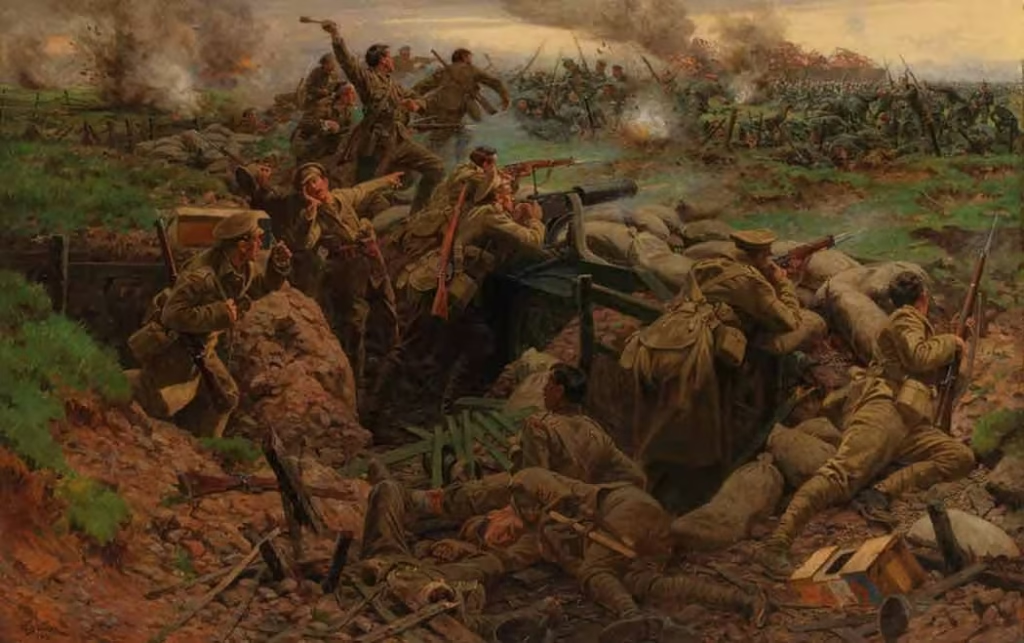
The historical reality of the Fall of Man is not an ancient myth confined to theological textbooks; it provides the primary diagnostic blueprint that explains the fractured human condition we encounter in contemporary global society. The systemic residuals of Genesis 3 manifest visually across our current landscape:
- The Crisis of Anxiety: The internal psychological fragmentation, identity confusion, and background radiation of modern anxiety stem directly from the underlying theological alienation—the suffocating reality of a soul attempting to function while detached from its relational Creator.
- The Broken Geopolitical Order: The ongoing reality of international warfare, structural injustice, and violent border conflicts is the direct corporate amplification of the original sociological alienation that entered the human heart.
- The Ecological Crisis: Disease, unexpected natural disasters, and biological frailty reflect the ongoing ecological alienation—the material cosmos groaning under the weight of introduced physical entropy (Romans 8:22).
Conclusion: The Absolute Necessity of a Savior
Ultimately, the rigorous study of the Fall of Man provides the definitive explanation for the existential paradox of reality: why a material universe originally brought forth by a perfectly benevolent Creator is currently saturated with suffering, injustice, and death. It demonstrates that humanity exists in a state of profound spiritual and moral bankruptcy—an accumulated debt to holy justice that it possesses zero inherent capacity to self-remedy.
By analyzing the true depth of our hamartiology, we are protected from the false hope of secular utopianism. We recognize that the human problem cannot be solved through mere political or educational engineering. Gaining a realistic view of the Fall causes us to look away from our own performance and appreciate the absolute heights of God’s redemptive provision, which culminates in the victorious cross of Jesus Christ.
For more scholarly research on the fall of man consider “The Fall of the Soul in Book Two of Augustine’s Confessions,” by Mateusz Strozynski.