The Sabbath Mandate: A Technical Theology of Rest and Resistance
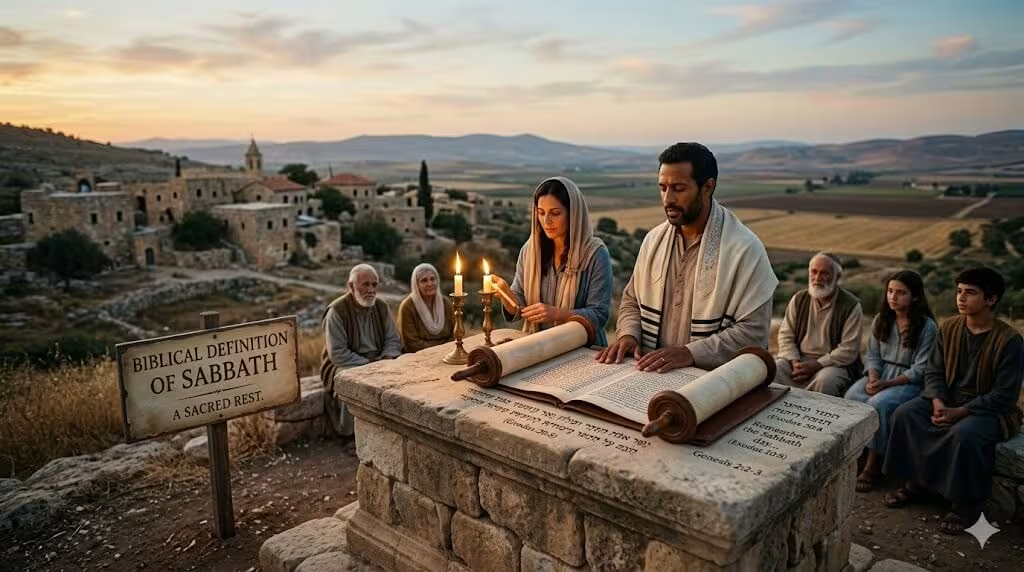
The concept of rest in the modern era has been reduced to a mere biological necessity—a temporary cessation of labor designed to maximize future economic productivity. However, a rigorous biblical analysis reveals that the Sabbath is not merely a break from work; it is a technical, covenantal mandate that serves as a primary defense for the somatic soul. By recovering the biblical definition of Sabbath, we discover that rest is an act of resistance against the idolatry of efficiency and a somatic alignment with the nature of God. For the believer, Sabbath is the liturgical rhythm that prevents the soul from collapsing into the stagnation of biblical definition of sloth.
The Philology of Rest: Shâbath, Nûach, and the Seven-Day Cycle
To define Sabbath properly, we must distinguish between the “stoppage” of work and the “dwelling” in rest. The Hebrew Bible uses distinct terminology that illuminate the somatic and theological depth of this mandate, moving it beyond a suggestion into a structural law of creation.
1. Hebrew: Shâbath (שָׁבַת) — The Volitional Cessation
Contrary to popular belief, Shâbath does not primarily mean “to sleep” or “to relax.” Its technical meaning is to stop or to cease. It is an active verb, indicating a conscious choice to terminate an ongoing activity.
- The Theological Implication: God did not “rest” on the seventh day because He was exhausted or depleted. He ceased His creative work because it was “very good” and complete. To keep the Sabbath is to mimic this divine cessation. It is a volitional act of the will to stop the “hunger” of the nephesh (soul) for more production and to declare that what has been provided is sufficient.
- The Provisionist Angle: This cessation is a universal provision. God did not design the human machine to run at 100% capacity indefinitely. By commanding cessation, He provides a structural “fail-safe” that protects the human agent from self-destruction. The will must choose to cooperate with this design, trusting that six days of labor under God’s provision are superior to seven days of autonomous striving.
2. Hebrew: Nûach (נוּחַ) — To Settle or Dwell
While Shâbath is the act of stopping, Nûach is the result. It refers to a state of being “at rest” or “settling down” (as the Ark settled on Ararat or as the presence of God “rested” on the Tabernacle).
- The Somatic Reality: This is where the body and soul find their equilibrium. If Shâbath is the “No” to work, Nûach is the “Yes” to God’s presence. It is the technical process of the Somatic Soul recalibrating its nervous system after six days of engagement with the fallen world. It is the “settling” of the heart’s anxieties.
The Technical Anatomy of the Sabbath Mandate
The Sabbath is anchored in two distinct “Why” statements in the Torah, each providing a different layer of the topical mesh for your site.
1. The Creation Mandate (Exodus 20): Mimicking the Creator
In the first giving of the Decalogue, the Sabbath is linked to the nature of God. We rest because He rested.
- The Imago Dei Connection: If we are made in God’s image, then our refusal to rest is a denial of our design. We are not “infinite creators”; we are finite “image-bearers.” Sabbath is the weekly technical reminder of our finitude. By stopping, we acknowledge that the universe continues to function without our intervention, thereby mortifying the pride that fuels biblical definition of greed.
2. The Liberation Mandate (Deuteronomy 5): Breaking the Slave-Cycle
In the second giving of the Law, the Sabbath is linked to the Exodus from Egypt. Moses reminds the people that they were once slaves who had no right to rest.
- Rest as Resistance: Pharaoh’s system was one of “endless production”—the quota of bricks never decreased. Therefore, for a redeemed person to refuse rest is to voluntarily return to a “Slave Mentality.” Sabbath is a political and spiritual declaration that we are no longer defined by our utility or our output, but by our standing as children of God.
The New Testament Refinement: Anapausis and Katapausis
When we move into the Greek text, the concept of Sabbath takes on a more “Restorative” and “Eschatological” tone, particularly in the teachings of Jesus and the book of Hebrews.
1. Christ as the Lord of the Sabbath
Jesus’ invitation in Matthew 11:28—”I will give you rest”—uses the word Anapausis. This refers to a “refreshment” or a “re-energizing.”
- The Healing Connection: Jesus performed many of His healings on the Sabbath to demonstrate that the purpose of the day was restoration. He was restoring the soma (body) to its rightful state of Shabat. This confirms our hub’s focus on Holistic Healing: true rest in Christ leads to the refreshment of the somatic soul.
2. The Remaining Rest (Hebrews 4)
Hebrews uses the term Katapausis, which refers to a “dwelling place” or a “final rest.”
- The Volitional Response: The author of Hebrews warns that some failed to enter this rest because of “disobedience.” This highlights that while the rest is provisioned for all, it must be entered by faith. It is a synergistic reality where the believer “strives to enter that rest” by ceasing from their own works. Attridge provides some guidelines on how to interpret the eschatology of Hebrews in “Let Us Strive to Enter That Rest” the Logic of Hebrews 4:1-11. The writer of Hebrews invokes the concept of labor before rest which harkens back to the relationship between faith and works. While some may debate about the implications of this relationship it is clear that one is saved to do good works in accordance with Ephesians 2:10.
Sabbath and the Somatic Soul: The Physiology of Rhythm
In 2026, the medical community increasingly recognizes “Circadian Dysfunction” as a root cause of chronic illness. The Bible anticipates this by mandating a “Circaseptan” (seven-day) rhythm.
1. The Neurobiology of Ceasing
The constant state of “doing” keeps the nephesh in a state of high cortisol and sympathetic nervous system activation. Chronic “Sloth” (in its form as acedia or spiritual heaviness) often stems from a soul that has been over-stimulated and under-rested. Sabbath acts as a “hard reset” for the somatic person. It allows the prefrontal cortex to disengage from “task-mode” and engage in “presence-mode.”
2. The Liturgical Renewal
By engaging in “Holy Rest,” the believer is not just being idle; they are engaging in a technical liturgy. This includes the “delight” of the Sabbath (Isaiah 58:13). Delight is a somatic experience—tasting good food, enjoying community, and engaging in worship. This re-trains the soul’s appetites to find pleasure in God’s attributes—His holiness, beauty, and provision—rather than in the “cheap dopamine” of digital consumption or greed.
The Economic Soul: Shemittah and the Denial of Greed
The Sabbath principle extends beyond the 24-hour day into the Sabbatic Year (Shemittah) described in Leviticus 25. Every seven years, the land was to rest.
- The Provisionist Test: This was the ultimate test of trust. God promised to provide a triple harvest in the sixth year to cover the seventh and eighth years. To obey was to trust in Divine Provision; to disobey was to lean on human production.
- Impact on the Mesh: This connects directly to our study of biblical definition of greed. Greed is the fear of “not enough.” The Sabbath year was the institutionalized cure for that fear, forcing the nation to rely on the nature of God as the Great Provider.
Thematic Mesh: Sabbath vs. The Vices
The Sabbath acts as a “Sanitizer” for the capital vices, cleaning the soul of the residues of the work week:
- Against Biblical Definition of Sloth: Sabbath is the “Healthy Rest” that prevents the “Unhealthy Sloth.” Acedia often thrives in those who are “burned out” and have lost the joy of their labor. By resting properly, we maintain the spiritual vitality required to avoid the apathy of Sloth.
- Against Biblical Definition of Lust: Lust is often a “counterfeit rest”—an attempt to find a somatic “high” to escape the boredom or stress of an un-rhythmed life. Sabbath provides the genuine somatic delight of worship and rest that makes the counterfeit less appealing.
- Against Biblical Definition of Greed: Sabbath is the weekly funeral for our desire for “More.” It is the physical proof that we trust God’s provision over our own production. It stops the “grasping” of the soul.
Technical Terminology: The Vocabulary of the Seventh Day
| Term | Language | Meaning | Application |
| Shâbath | Hebrew | To Cease / Stop | The volitional end of production. |
| Nûach | Hebrew | To Settle / Rest | The somatic result of holy cessation. |
| Anapausis | Greek | Refreshment | The restoration of the soul’s vitality in Christ. |
| Katapausis | Greek | Final Dwelling | The eschatological rest of the believer. |
| Enkrateia | Greek | Self-Control | The discipline required to stop working. |
Summary: The Sanctuary in Time
The biblical definition of Sabbath is the creation of a “Sanctuary in Time.” While the world offers “vacations” and “entertainment”—which often leave the soul more exhausted—the Word of God offers Restoration. By aligning our somatic soul with the rhythms of the nature of God, we move beyond the frantic anxiety of the modern age into the “Quiet Waters” of divine provision.
Sabbath is not an optional suggestion for the super-pious; it is the technical mechanism by which we remain human in an inhumane, 24/7 world. It is the volitional response of a soul that has found its sufficiency in the Creator, resting in the provision that was secured before the foundations of the world.
FAQ: Scholarly Questions on Biblical Sabbath
Q: Is the Sabbath still a commandment for Christians today?
A: While the ceremonial and civil aspects of the Mosaic Sabbath were fulfilled in Christ, the “Creation Mandate” of rest remains a technical necessity for the human design. Christians typically observe this principle through the “Lord’s Day,” recognizing that the need for rhythmic cessation is part of the Imago Dei.
Q: How does Sabbath rest differ from just being lazy or “Slothful”?
A: Sloth (acedia) is a spiritual neglect or a refusal to do what is right. Sabbath is a disciplined, holy “ceasing” done in obedience to God. Sloth drains the soul; Sabbath refills it. Sloth is an escape from duty; Sabbath is a duty of delight.
Q: What if I can’t afford to take a day off?
A: From a Provisionist perspective, the Sabbath is a test of trust in God’s provision. The “double portion” on the sixth day in the wilderness was God’s way of showing that He can do more with our six days of obedience than we can do with seven days of striving. It is an invitation to rely on His grace.