

The biblical definition of peace is an expansive construct that fundamentally transcends the secular notion of a mere cessation of hostilities or a fleeting state of emotional tranquility. In the modern vernacular, peace is often relegated to the realm of psychology—a subjective feeling of calmness in the absence of external pressure. However, within the technical framework of scriptural scholarship, peace is presented as a structural, relational, and ontological reality. It is the presence of wholeness rather than the absence of conflict.
This virtue represents the active restoration of the human agent to a state of functional alignment with the divine order. To comprehend the depth of this concept, one must engage in a rigorous philological investigation of the transition from the Hebrew Shalom to the Greek Eirēnē, recognizing that true peace is the mechanical byproduct of a life integrated into the standard of the Creator.
The Linguistic Bedrock: Shalom and the Mechanics of Wholeness
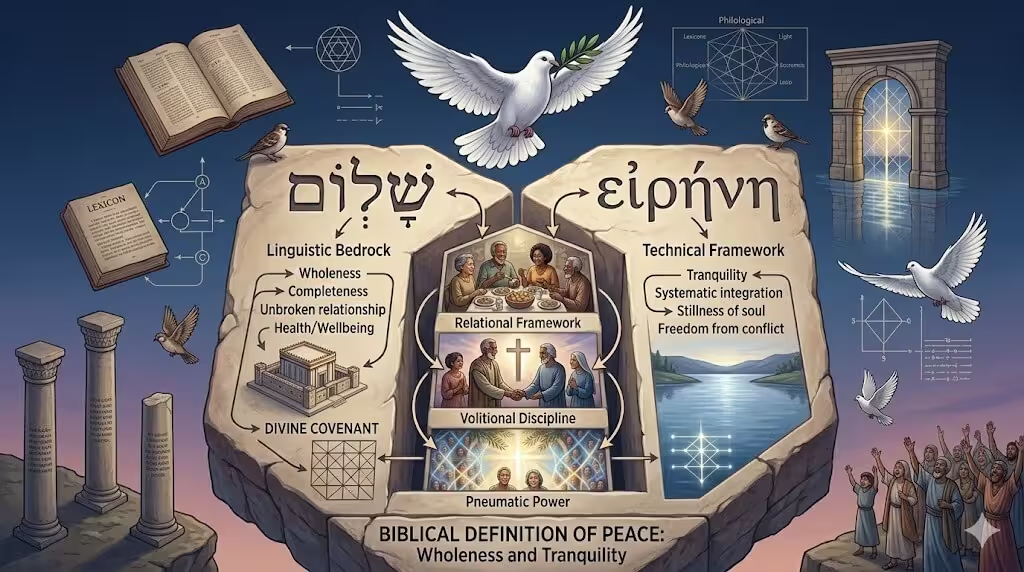
Any authoritative study of the biblical definition of peace must begin with the Hebrew term Shalom (שָׁלוֹם). Unlike the English word “peace,” which often feels passive, Shalom is a high-energy term denoting completeness, safety, and prosperity.
1. The Etymology of Completion and Finish
The Semitic root š-l-m carries the primary sense of being “whole” or “uninjured.” In ancient Near Eastern contexts, this root was utilized in various technical capacities. When a building project was brought to its intended conclusion, it was described as shalam. When a financial obligation or a legal debt was satisfied in full, it was shalam.
This linguistic background informs the biblical understanding of peace as a “finished” state. Peace exists when a system—whether it be the internal environment of an individual or the external structure of a society—is exactly as it was designed to be, with nothing missing and nothing broken. It is the technical restoration of “design intent.”
2. The Septuagintal Transition and Eirēnē
When the scholars of the Septuagint (LXX) translated the Hebrew scriptures into Greek, they predominantly utilized the term Eirēnē (εἰρήνη). In classical Greek thought, Eirēnē was often a socio-political term, representing a state of national stability as opposed to the chaos of war (polemos). The New Testament writers, however, infused this Greek term with the expansive Hebrew meaning of Shalom.
Consequently, the Apostolic biblical definition of peace represents a “harmonious order.” It is the state where every constituent part of the human economy—the physical, the emotional, and the spiritual—is in its proper place, functioning in accordance with the atmosphere of the divine life. This order is not forced from the outside; it is a pneumatic reality that flows from the center of a life centered on God.
The Technical Anatomy of Peace: The Three Planes of Shalom
Peace is not a static attribute but a relational dynamic that operates with mechanical precision across three distinct planes of existence: the vertical, the internal, and the horizontal.
1. Vertical Peace: The Judicial Resolution
The primary “mechanic” of peace in the scriptural witness is the resolution of enmity between the Creator and the creature. Because the state of sin represents a judicial and relational breach, the path toward peace begins with a legal settlement.
- The Resolution of Hostility: As explored in our deep dive into the judicial and relational resolution of the Cross, the believer is “justified by faith” and subsequently enters a state of “peace with God.” This is not an internal feeling of serenity, but a permanent change in legal status. The state of rebellion has ended, and the “war” between the soul and the Creator has been finalized.
- The Prerequisite of Order: This vertical reconciliation serves as the technical prerequisite for all other forms of peace. One cannot maintain a stable internal state if the “Source of Being” is in a state of judicial opposition to the “Human Agent.” Peace begins as a legal standing before it ever becomes a psychological experience.
2. Internal Peace: The Garrison of the Soul
Once the vertical status is secured, the biblical definition of peace manifests as an internal protective mechanism. The Apostle Paul famously describes this in the Philippian correspondence as a peace that “guards your hearts and minds.”
- The Phroureō Mechanic: The Greek term for “guard” (phroureō) is a technical military term referring to a garrison standing watch over a city. In this sense, peace is the “soldier” that prevents the disordered appetites of the world from breaching the perimeter of the soul.
- The Antidote to Internal Agitation: This internal peace is the technical solution for the “boiling” of the spirit. While a soul in a state of high-friction agitation represents a loss of self-regulation and a breach of the soul’s defenses, Eirēnē represents a state of “fluidity”—the ability to act with clarity without being caught in the gears of bitterness or reactive fear.
Peace as the Technical Corrective to Capital Vice
Within our restorative web, the biblical definition of peace serves as a direct antidote to the fragmentation caused by the capital vices, specifically addressing the instability found in the “Self-Seeking” sins.
1. Correcting the Internal Rot of Envy
Envy is a state of “un-peace.” It is a constant vibration of the soul caused by a perceived deficiency in one’s own “portion” compared to another’s.
- The Wholeness Cure: Peace (Shalom) provides the “contentment of completion.” If the soul recognizes its wholeness in its relationship with Christ, it no longer needs to “consume” or diminish the success of others to feel secure. In our scholarly study of the state of high-friction internal rot, we noted that envy is a corrosive force. Peace is the “marrow” that heals that rot, providing an internal satisfaction that is independent of social comparison.
2. Correcting the Chaos of Wrath
Wrath represents the “explosive” failure of peace—the result of a soul that has lost its internal garrison.
- The Regulatory Function: Peace provides the necessary time and space for the exercise of long-suffering. By establishing a base level of internal stability, the human agent can process perceived injustices through the lens of divine justice rather than reacting with somatic violence. Peace is the buffer that prevents the “spark” of offense from becoming the “inferno” of unrighteous anger.
Historical Theology: The Tranquillitas Ordinis
To understand the biblical definition of peace in its proper scholarly context, we must examine how the early and medieval church technicalized this state of being.
1. Augustine’s “Tranquillity of Order”
St. Augustine famously defined peace as tranquillitas ordinis—the tranquility of order. For Augustine, peace was not merely “quiet,” but “right arrangement.”
- The Hierarchy of the Soul: Peace exists when the lower parts of a system are in voluntary subjection to the higher parts. In the human person, this means the body is in subjection to the soul, and the soul is in subjection to the Creator.
- The Somatic Cooperation: This is why we have emphasized the cooperation of the physical frame in our restorative studies. If the body’s physical rhythms are in a state of chaos, the soul will struggle to maintain its “Tranquillity of Order.” True peace requires a somatic partnership.
2. Pax Romana vs. Pax Christi: A Conflict of Mechanics
The early Christians lived under the Pax Romana—a peace established through imperial conquest and maintained through the constant threat of force.
- The Immanent Alternative: When Jesus stated, “My peace I give to you; not as the world gives,” he was offering a technical critique of Roman political peace. The biblical definition of peace is an “immanent” peace—it does not require the removal of external enemies to function. It exists in the middle of a dungeon or a storm. It is a peace of “presence” rather than a peace of “absence.”
The Mechanics of Cultivation: The Rhythms of Shalom
How does the human agent practically “enact” this peace? It is not a magical, instantaneous impartation but a cultivated rhythm of life that aligns the person with the original design.

1. The Sabbath as a Factory for Peace
There is a technical and linguistic reason why “Shalom” and “Sabbath” are linked in the Hebrew mind. The Sabbath is the “Palace in Time” where wholeness is manufactured and restored.
- The Cessation of Friction: By ceasing the work of production and the act of consumption, as outlined in the physical manifestation of wholeness, the human agent stops the “striving” that causes internal friction. The Sabbath is peace in physical form—a day of being “whole” without the need for “doing.” It is the recalibration of the soul to its vertical source.
2. The Liturgy of Lament as a Path to Peace
It may seem counterintuitive to link grief with peace, but in the biblical economy, peace is often the result of honest, structured sorrow.
- Clearing the Static: As explored in our guide to the processing of pain in the presence of the Provider, unexpressed or repressed grief acts as a “blockage” to internal peace. By liturgically releasing that pain to God, the soul clears the “static” that prevents the “Tranquillity of Order” from returning. Peace is not the denial of pain, but the successful processing of it.
The Somatic Result: Peace as Biological Integrity
Because the human person is a unified being, the presence of the biblical definition of peace has tangible, measurable biological consequences. In our technical study of scriptural wellness, peace is the “baseline” for holistic health.
1. The Neurobiology of Shalom
When the mind is “stayed on Him,” the nervous system moves from a “Sympathetic” state (fight or flight) to a “Parasympathetic” state (rest and digest).
- The Body Whole: Peace creates the physiological conditions necessary for cellular repair, stabilized heart rates, and cognitive clarity. It is the biological echo of the spirit’s wholeness. To have peace is to give the body the environment it needs to function at peak capacity.
2. The Participating Attribute
Ultimately, peace is a communicable attribute. We have peace because we serve the “God of Peace.” In our examination of the character of the Creator, we see that the Trinity exists in a state of eternal, perfect, friction-less communion. To experience the biblical definition of peace is to participate in the very presence of the divine life, moving beyond the fragmented self and into the wholeness of the divine intent.
Technical Conclusion: The Garrison of the Redeemed
In conclusion, the biblical definition of peace is a structural wholeness that guards the human agent against the fragmentation of a fallen world. It is the Shalom that makes the system complete and the Eirēnē that keeps the system in order. It is the mechanical byproduct of a justified spirit, a governed body, and a rhythmic life. Peace is the “Broad Place” where the soul no longer has to strive for significance or safety, because it is anchored in the finished work of the One who is our Peace. By choosing the path of wholeness, the image-bearer moves from the friction of the world into the tranquility of the Kingdom.
For further study read “Peace in the Pauline Letters: A Perspective on Biblical Spirituality” by Pieter G.R. de Villiers. He contrasts the Roman view that peace came from the emperor with the biblical concept of peace as a fruit of the Holy Spirit.