
The biblical definition of greed reveals a sinister reality: a fundamental disordering of the soul that replaces trust in the Creator with a frantic dependence on the creature. Yet, Greed, or avarice, is frequently categorized in modern economic discourse as a necessary driver of growth or a neutral byproduct of ambition. Within the technical framework of the seven deadly sins, greed is not merely the desire for more, but the “inordinate love of riches” that effectively severs the individual from the covenantal community and the divine life.
Greed is the spiritual manifestation of a “scarcity mindset” that refuses to acknowledge the abundance of God’s providence. To understand the biblical definition of greed is to move beyond the surface of bank accounts and material possessions to investigate the linguistic roots of “grasping,” the mechanics of spiritual alienation, and the redemptive restoration of stewardship in the New Covenant.
Linguistic Bedrock: The Philology of Grasping and Coveting
The biblical authors employed a precise and varied vocabulary to describe greed, focusing on the internal desire as much as the external accumulation. A technical exegesis requires a distinction between the “desire for gain” and the “unlawful seizing” of what belongs to another.
Hebrew Terminology (Old Testament)
The Old Testament vocabulary for greed is often visceral, connecting the sin to the throat, the breath, and the act of swallowing.
- Beṣa‘ (בֶּצַע): This is the primary term for “unjust gain” or “covetousness.” Etymologically, it comes from a root meaning “to cut off” or “to break off.” It implies a gain that has been severed from justice or a profit made by “cutting off” the life or livelihood of another. In Habakkuk 2:9, the prophet pronounces woe on those who “get evil gain” (boṣea‘ beṣa‘ ra‘) for their house, highlighting the destructive nature of accumulation at the expense of others.
- Chamād (חָמַד): Frequently translated as “to covet” or “to desire,” this term appears in the Tenth Commandment (Exodus 20:17). While desire can be neutral, chamād in this context refers to a “lust of the eyes” that seeks to possess what God has assigned to another. It is a rebellion against the divine distribution of resources.
- ’Avah (אָוָה): This term emphasizes the intensity of the craving. It describes a “longing” or “pining” after material things. When paired with the “soul” (nephesh), it depicts greed as a physiological hunger that is never satisfied, as seen in the warnings of the Wisdom literature where the greedy person is compared to a leech that always cries, “Give! Give!” (Proverbs 30:15).
Greek Terminology (New Testament)
The New Testament terminology elevates greed to a matter of cosmic allegiance, specifically identifying it as a rival religion.
- Pleonexia (πλεονεξία): This is the quintessential term for the biblical definition of greed in the New Testament. Etymologically, it means “the desire to have more” (pleon + echo). It is the ruthless self-seeking that refuses to be satisfied. Paul provides the ultimate technical definition in Colossians 3:5, where he explicitly equates pleonexia with idolatry. Greed is not just a moral failing; it is the worship of a false god.
- Philargyria (φιλαργυρία): Literally “love of silver” or “love of money.” This term appears in the famous warning of 1 Timothy 6:10. It is a technical description of the disposition of the heart. Money itself is neutral, but the “philia” (affection/friendship) for it is the root of all kinds of evils.
- Aphilargyros (ἀφιλάργυρος): The negative form, “not a lover of money,” is listed as a technical requirement for church leadership (1 Timothy 3:3; Hebrews 13:5). It implies a state of being “free from the love of money,” which is the necessary prerequisite for spiritual authority.
Technical Framework: The Theological Mechanics of Greed
The biblical definition of greed functions through the mechanics of trust, the rejection of the Imago Dei as a steward, and the adoption of a “scarcity” worldview.
The Idolatry of Mammon
Theologically, greed is the attempt to find security and identity in the “non-living.” Jesus personifies this as Mammon (Matthew 6:24). In the technical sense, Mammon is not just a currency; it is a “totalizing system” that demands the same allegiance as God. The mechanic at work here is the “displacement of trust.” Instead of relying on the Jehovah Jireh (the Lord who provides), the greedy person relies on their storehouses. This displacement effectively “de-gods” God and “en-gods” the bank account.
Sin, Death, and the “Pierced” Soul
Greed is “deadly” because it produces a unique form of spiritual and physical alienation. Paul describes those who crave riches as being “pierced… with many pangs” (1 Timothy 6:10). Theologically, greed creates an “infinite vacuum” in the soul. Because material things are finite and the human soul is made for the infinite (God), the greedy person is caught in a mechanical loop of diminishing returns. The more they accumulate, the less satisfied they become, leading to a state of spiritual “atrophy” where the capacity for joy is replaced by the anxiety of preservation.
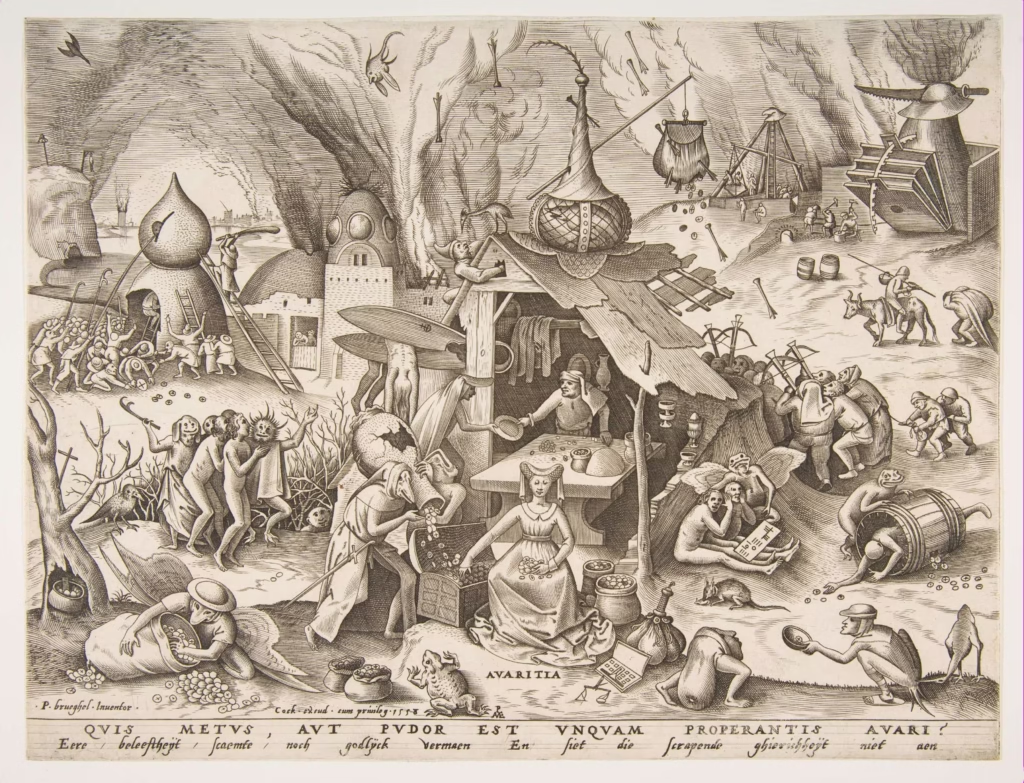
Historical Context: ANE and the 1st-Century Roman Economy
The biblical witness regarding greed was a direct challenge to the “extractive” economies of the surrounding cultures.
Ancient Near Eastern (ANE) Perspective
In the ANE, wealth was often viewed as a sign of divine favor, but it carried heavy social obligations. The “Year of Jubilee” and the “Sabbatical Year” in Israel were technical legal mechanisms designed to combat the “accumulation of land”—the primary form of greed. Unlike the surrounding nations where the king owned everything, in Israel, the land belonged to God (Leviticus 25:23). Greed, in the form of “adding field to field,” was viewed as a direct assault on God’s land-tenure system and the economic survival of the poor.
1st-Century Greco-Roman Context
In the 1st-century Roman world, the economy was “zero-sum.” Wealth was seen as a limited pool; for one person to get more, someone else had to have less. Greed was not just an internal vice but a form of social “cannibalism.” The New Testament writers, speaking into this “Honor-Shame” culture, redefined wealth as “stewardship.” The technical innovation of the New Testament was the concept that the believer is a “manager” (oikonomos) rather than an “owner.” This directly attacked the Roman idea of absolute property rights.
Thematic Mesh: From the Garden to the New Jerusalem
Greed connects to the overarching narrative of Scripture through the themes of “Manna,” “Covenant,” and the “Propitiation” of Christ.
Adam and the Desire for More
While the first sin is often called pride, it had the mechanical structure of greed: the desire for “more” than what God had provided. Adam and Eve were given the entire garden but “coveted” the one thing withheld. They traded their “covenantal abundance” for a “scarcity-driven theft.”
Christ: The Kenosis as the Remedy
The ultimate remedy for greed is the Kenosis (the self-emptying) of Christ. As Paul writes in 2 Corinthians 8:9: “For you know the grace of our Lord Jesus Christ, that though he was rich, yet for your sake he became poor, so that you by his poverty might become rich.” Christ is the technical “reversal” of greed. Where greed seeks to grasp (pleonexia), Christ seeks to give (charis). This “Great Exchange” provides the believer with an “inheritance that is imperishable,” which kills the internal need for greedy accumulation.
The Ascetic Response: An Eastern Perspective on Overcoming Greed
The technical remedy for the biblical definition of greed requires more than a cognitive shift; it demands a somatic and spiritual reorientation. As Valerie A. Karras explores in Overcoming Greed: An Eastern Christian Perspective, the Patristic tradition views greed as a symptom of philautia (self-love) and a failure to recognize our ontological interdependence.
From this Eastern perspective, greed is not merely an ethical infraction but a spiritual sickness that is cured through the practice of asceticism—specifically the “almsgiving of the heart.” By voluntarily detaching from the “grasping” impulse of the fallen nature, the believer creates a vacuum that can only be filled by the uncreated light of God. This scholarly framework moves the conversation of greed away from modern moralizing and back toward the ancient “Therapeutics of the Soul,” where generosity functions as the mechanical antidote to the gravity of avarice.
Technical Comparison: Stewardship vs. Greed
To assist researchers in the categorization of financial dispositions, the following table outlines the mechanical differences between biblical stewardship and the vice of greed.
| Feature | Biblical Stewardship | Biblical Greed (Avarice) |
| Primary Allegiance | God (The Giver) | Mammon (The Gift) |
| Mechanic of Trust | Reliance on Providence | Reliance on Accumulation |
| View of Resources | Entrusted Talent (Oikonomos) | Personal Possession (Pleonexia) |
| Social Result | Generosity and Hospitality | Exploitation and Hoarding |
| Spiritual Goal | Contentment (Autarkeia) | Insatiable Desire (Chamād) |
| Linguistic Root | Charis (Grace) | Beṣa‘ (Unjust Gain) |
| Final End | Eternal Reward | Spiritual Ruin and Pierced Souls |
The Ethical Economy of Stewardship
The biblical definition of greed must be understood through the lens of divine stewardship rather than mere possession. In both the Old and New Testaments, the management of material goods is a sign of internal allegiance. The laws regarding the sabbatical year and the prohibition of usury were designed as technical barriers against the “infinite accumulation” of wealth. These laws functioned to remind the individual that the earth and its fullness belong to the Creator, not the consumer.
In the early church, this was elevated to a communal ethic of radical generosity. Greed in the body of Christ was viewed as a spiritual malignancy because it causes one member to hoard resources while another suffers lack. By practicing a shared economy of grace, the community demonstrated that the “god of Mammon” had been defeated. This was not a political mandate but a technical outworking of the belief that the believer is a manager (oikonomos) of God’s resources, tasked with distributing them to reflect the character of a generous Father.
The Structural Shift: Greed in the Modern Age
The transition from ancient agrarian greed to contemporary financialized avarice reveals that the biblical definition of greed has become systemic. As explored in the scholarly analysis by Christopher D. Jones and Conor M. Kelly, greed often manifests as a “structural vice” where systems of consumption are designed to keep the human heart in a state of perpetual dissatisfaction. In the 2026 digital economy, greed is amplified by the “attention economy,” where the desire for “more” is no longer just about silver, but about “digital capital”—influence, data, and social standing.
Summary: The Cure of Contentment
In conclusion, the biblical definition of greed is the insatiable hunger of a heart that has forgotten how to trust. It is a “root of all kinds of evils” because it forces the individual to treat God as a competitor and their neighbor as a resource. The remedy is found in the technical discipline of Contentment (autarkeia). This is not a passive acceptance of poverty, but an active, spiritual “fullness” that comes from knowing that one’s life is hidden with Christ in God. For the pastor and researcher, addressing greed is a call to move the community from a “theology of scarcity” to a “theology of abundance,” where the only thing we “grasp” is the promise of eternal life.