

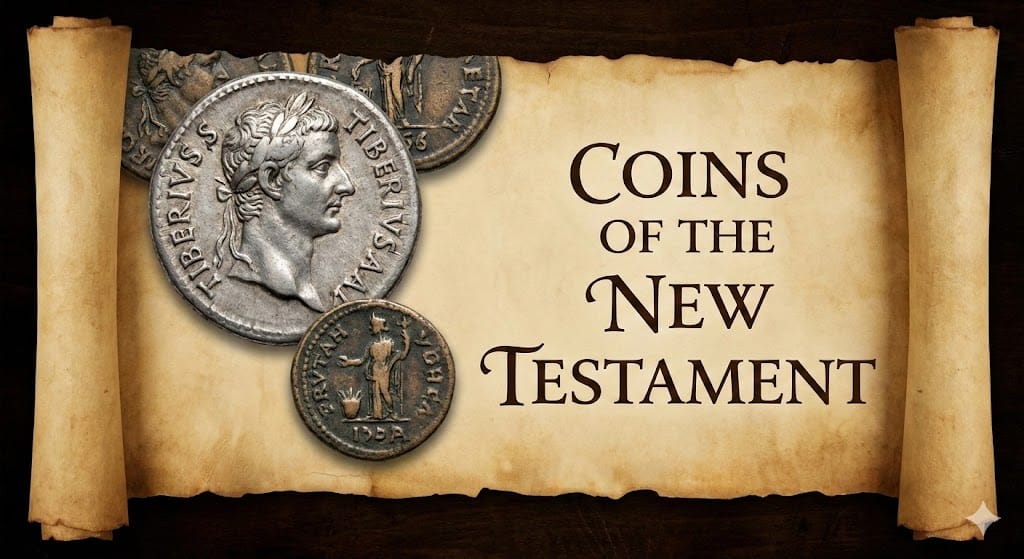
A Research Guide to New Testament Coins
Studying New Testament coins is one of the most exciting areas of biblical archaeology. Coins are an important piece of archaeological exploration because they provide context to the rest of an excavation. Modern tools make metal varieties especially easy to find, and for this reason there are extensive catalogs which document previous finds.
Table of Contents
Key Takeaways from this Research:
- Scientific Confirmation: Modern X-ray diffraction allows us to trace the metal in coins to specific historical events mentioned in Scripture.
- The Tribute Penny: The coin shown to Jesus likely bore the inscription “Son of the Divine Augustus,” a direct challenge to Christ’s divinity.
- The Widow’s Mite: Identified as a lepton, this was the smallest copper coin in circulation, roughly 8mm in size.
- Pilate’s Existence: Coins and inscriptions from Caesarea Maritima definitively prove the titles and roles of Pontius Pilate and other officials recorded by Luke.
Studies of coins can now take a deeper look at composition and formation through metallography, x-ray diffraction, and x-ray fluorescence. These findings are cataloged and categorized down to the elemental composition of the coin. This can help identify where the coin was made and where the metal came from even on coins that have no visible markings left on them due to weathering or damage.
While this makes coins easier to find, people who are only interested in monetary value and not the archaeological data may not document the finding properly or explore the context of the site. Many archaeological sites have been vandalized intentionally by treasure hunters over the years. This is unfortunately because coins limit guesswork and provide a great deal of context to the dating, politics, and economy of ancient sites. Thankfully, archaeologists continue to do great work and find coins along the way.
Thankfully, archaeologists continue to do great work and find New Testament coins along the way. For biblical archaeology there will not be a coin featuring Jesus, but the contents of the Bible have been confirmed by coins that commemorate political figures and therefore can be used to date things recorded in Scripture. Inscriptions on coins prove the existence of characters in the Bible whose existence may otherwise have been challenged at times and can sometimes verify the accuracy of the titles and offices attributed to the figures by the authors of the Bible. This research paper will explore what Roman coins of the first century BC and AD convey and connect that information to coins and culture of the New Testament.
How Archaeologists Date and Analyze New Testament Coins
The life cycle of a coin starts in pre-production planning to determine the composition of the coin, the images that will appear on its faces, how many will be made, where it will be made, and where it will be circulated. From there it enters circulation, and its use is determined by who will accept it as tender for transactions. At some point it is either recycled for the metal, discarded, or deposited. It may then be found and recovered by some human activity and hopefully the find is recorded and documented so it can further scientific study.
Despite not having dates on them, Roman coins are typically easy to date because of the Roman tradition of using coins, weights, monuments, and documents to commemorate notable events. Coins can be cross-referenced with these other records to provide narrow periods in which they were minted. Victories, achievements, mintmarks, and political appointments are just some examples of what is documented on coins that can help date them.
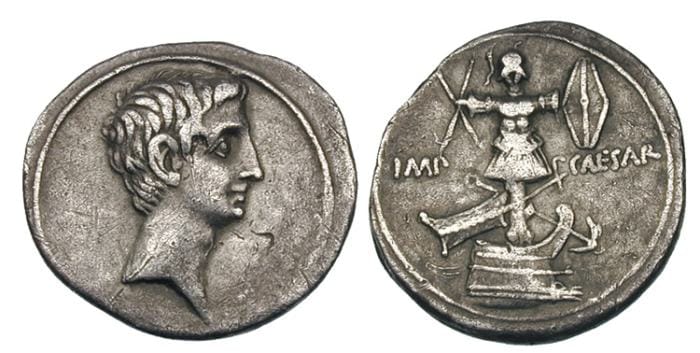
What is considered imperial coinage of Rome began in 29 BC when Octavian began issuing coins that read “IMP CAESAR”, but it was not metallurgically distinctive until Augustus the gold, silver, and bronze system to a gold, silver, brass, and copper system accordingly to Mattingly and Cope. Augustus kept control of minting gold and silver coins while he gave the Senate the power to issue brass and copper coins hence the mark “S.C.” for Senatus consulto (Sear, 2004). For reference, the lowest value coin was a copper quadrans which was .25 of a copper as. The brass dupondius was equivalent to two copper asses, and the brass sestertius was four copper asses. The silver denarius was 16 copper asses. The highest value coin was a gold aureus which was equal to 25 silver denarii. There were a few other types in between and this system was altered in the future, so the list is just to give an idea of how some of the coins compared in value as some will be mentioned again in this paper.
Sutherland eloquently said,
“The imperial coinage furnishes what is at once the most voluminous, the most constant, the most official, and the most accurate series of [Roman] documents that has come down to us. Though its multiple voice spoke softly of some things and declined altogether to mention others, it was comprehensive, authentic and personal. It was planned for an audience of countless thousands, all of whom, in greater or less degree, looked to the princeps as the apex of a political system on which depended the peace and stability of the civilized world; and it furnished world opinion with a miniature but strictly official commentary upon the man and his administration.”
The Roman imperial coinage is still yielding information that helps give insight to ancient history including that of the Bible.
Roman Coins as Imperial Propaganda
The ancient Romans did not miss the opportunity to use coinage as propaganda at any time in their history. At times it was simple and subtle, displaying the head of a Roman soldier or “Roma” on the obverse side and the she-wolf of the Roman foundation mythology on the reverse side to honor their military and history. Around 110 BC the Roma head was often replaced by various deities and legendary heroes, most frequently, Jupiter, Juno, Mars, Apollo, and Venus. Political factions and powerful families adopted these gods as symbols and used them on coins to express their achievements and family history. Luce highlighted a particular instance between Sulla and Marius during the 80s BC involving the use of Apollo and Venus. However, it appears that the coins were a point of pride more than effective propaganda.
However, the process was only mastered and most frequented during the imperial period. Caesar Augustus allowed coins to be minted in 150 cities around the empire under imperial supervision and in close relationship to his main imperial coins (West, 1949). The crowning of a new emperor meant the issuing of a new coin to commemorate the event. But that was just the first of a series that each ruler would produce. Rowan highlighted how Roman coinage was kaleidoscope of different ideologies and images based on particular moneyers who made it and what region it was minted in until the imperial system came along and put the focal subject of coin imagery squarely on the emperor.
Augustus used coins to celebrate victory over Antony and featured the crocodile on the reverse because it was a symbol of Egypt. He also circulated coins in the eastern empire when they defeated the Parthians to emphasize that Rome had firm control over the region. Similarly, Claudius used coins to mark his victory in Britain, Vespasian over Judea, and Domitian over Germany. Nero and other later emperors even used coins to celebrate times of peace in the empire. Caligula minted a coin to remind the public that he abolished a sales tax in Rome. Nerva made a coin to honor his overturning of a discriminatory tax on Jews in the empire (West, 1949).
In the early 2nd century, there was a coin propaganda debacle. According to Burnett’s study and conclusion, Trajan tried to mint a coin after his rushed adoption of Hadrian, died a few days later, and the mints at Rome, Antioch, and Alexandria all gave Hadrian the titles of Trajan with Alexandria bungling the spelling of Hadrian’s adoptive name. Hadrian had to act fast to correct the errors and establish his new power in Rome. His journey would take him out of Iraq, back to the capital, and within five years he would visit Britain and commission the building of the famous Hadrian’s Wall, a well-traveled emperor indeed.
In ancient Rome, minting coins that put the message directly into the people’s hands was the most effective way to spread propaganda across the empire. The message could be tailored to a certain region by doing a limited release on the outskirts of the empire. Putting the message on a lower value copper coin would make sure that more people received it. If the wealthy needed to hear the message it would go on a gold aureus. Other methods such as posting a decree at the entrance to a town or a public square got fewer views, and a monument likely less. A shiny new coin would draw the eye of anyone making a transaction.
At Bethsaida, the sequence of coins shows an unbroken line from Hasmonean control to Herod taking the throne and indicates it might have been established during peace time, peaked in the Seleucid era and declined through Roman control in the first century AD (Savage, 2007). Sometimes the propaganda had an adverse effect. In Galilee, archaeologists have found coins minted by Herod Antipas that had no images and oil lamps that were atypically without any decorative figures on them (Ed. Fiensy and Hawkins, 2013). The vast majority of coins in this area date to the Hasmonean era and it is probable that the locals favored these coins over the imperial ones. Most likely this was in protest of the imperial cult that was represented by images on coins. In accordance with the second commandment, the Jews could not have any graven images of any gods.
The imperial cult started at the death and deification of Julius Caesar in 44 BC. The Romans began to worship deceased emperors, but some emperors minted coins to link themselves with various deities. For example, Domitian favored Minerva, a deity associated with war and wisdom, Jupiter, and Mars (Sear, 2004). He instituted many moral and religious reforms in Rome including persecution of Christians. This could be because of their aversion to the Roman imperial cult and emperor worship.
Domitian was known for exiling John to Patmos. He was not liked by the Senate, and he was assassinated by court officials. He was one of the few emperors to receive an order of damnatio memoriae which meant every record of his was to be destroyed. It does not appear that they worked hard to destroy the record, especially with coins since so many survived and have been discovered by archaeologists. The culture of the region changed in the 2nd century AD when Roman troops began a long-term occupation of the region. Coins began to have more pagan imagery, Sepphoris became Diocaesarea, and more pagan artifacts were unearthed in these later layers until Bethsaida was abandoned in the early 4th century (Savage, 2007).
The Science of Coinage: Composition and the Economy
The previously mentioned shift from bronze to brass and copper under Augustus was not just an arbitrary decision. Cope attributed the change to either the vast amount of copper gained from Augustus’ annexation of the Iberian peninsula or a shortage of tin that existed from Augustus to the Roman conquest of Britain (Cope, 1974). Another example of possible resource allocation problems under Augustus is in the XRF data on coins from 9 AD which show a significant rise in lead content that correlate to the loss of three legions in Germany, and drop to near zero percent in 17 AD which coincides with Tiberius’ reforms that required pure copper asses for tax payments in Palmyra, Syria (Bower, Hendin, and Burt, 2017). Changes in coin composition seemed to affect the eastern empire more since Rome was favored and most of the copper and silver came from Spain.
Another significant change in the composition of New Testament coins was the decline of the denarius which had a silver content of 90% or more until it began to decline under Nero (Middelkoop, 2016). This trend continued through the second century under Caracalla who had the denarius down to 40% silver and further debased the coinage system by adding a new coin, now named after him and called an antoninianus, which had the weight of 1.5 denarii but was tariffed as 2 denarii (Sear, 2004). In the 70s AD the Flavian dynasty began producing bronze, brass, and copper coins in Antioch, Cyprus, and other locations in Asia Minor (Carradice and Cowell, 1987). This move coincided with a cessation of silver denarii production in the some of the same mints and the diaspora that followed the destruction of the Temple. During the second century the empire was faced with a silver shortage that led the emperors choosing to further debase the denarius instead of raising taxes (Butcher, 2012). Some emperors such as Domitian temporarily raised silver and gold standards, but the overall trend to debase currency persisted and contributed to the collapse of the empire.
Biblical Mentions of New Testament Coins
Matthew 10:29 and Luke 12:6 are biblical examples of a buy two get the third half off deal. Matthew asks if two sparrows are sold for 1 assarion while Luke asks if five sparrows are sold for two assarion. Strong rightly identifies these New Testament coins with the Roman as and compares it to .1 drachma (Strong, 2009). Other sources wrongly identified it as a brass coin while the as is a copper coin or considered the assarion an accounting term rather than a coin. However, it appears quite obvious from data that this is the Roman copper as, or a Jewish alternative coin of the same name.
The Widow’s Mite (The Lepton and Quadrans)
Mark 12:42 mentions a poor widow that gives two lepta and that it is equal to one quadrans. The copper quadrans was the smallest official coin under Augustus but it is possible there were smaller denominations initiated later under Tiberius. There is too much debate in the research to draw any solid conclusions about what New Testament coins could be the lepton. However, the Scripture is clear about the value and therefore the size should be half of the quadrans making it about 8mm in diameter.
The Temple Tax and the Fish’s Mouth (The Stater)
Matthew 17:24-27 tells the story of Peter’s encounter with tax collectors in Capernaum. Peter acknowledges that Jesus pays taxes, Jesus teaches that the tax is unfair, and Jesus says to pay it anyway to not offend the authorities. Part of the unfairness of the tax might have been that it was a temple tax, but it paid for civic projects. These taxes were used to make a bridge across the Kidron Valley, maintain the aqueducts, and according to Josephus, Agrippa II used them to pave the city with white stone (Stevens, 2002). The Scripture says that this particular tax is two drachmas. Jesus tells Peter to go fish and that his catch will have a statera in its mouth. This is rendered as a four-drachma coin because Jesus tells Peter it will pay the tax for both of them.
Scripture accurately shows that the preferred New Testament coins in Galilee were different than in Jerusalem. Archaeologists have found an abundance of Hasmonean coins at Jewish sites throughout Judea, Galilee, and the Golan as well as a lack of Hasmonean coins at pagan sites (Ed. Fiensy and Hawkins, 2013). Again, this is likely due to the Jews trying to honor the second commandment and refrain from imperial coinage.
However, the Tyrian shekel had the image of Baal on the obverse and must have been considered the lesser of two evils compared to their Roman oppressors. The Tyrian shekel was the regional standard silver coin and the only one excepted for payment of the temple tax there (Ed. Fiensy and Hawkins, 2013). Therefore, it was either the stater, the equivalent of two drachmas, or the tax was a half shekel. Syon confirms that it had to be Tyrian silver because the overwhelming majority of Roman silver in the area was found in hoards which do not reflect circulation while the non-silver coins reflect that the Jews of Galilee were using locally minted Hasmonean or Herodian coins (Syon, 2004).
The Tribute Penny: Rendering Unto Caesar
In Matthew 22:17-21, the Herodians in Jerusalem ask Jesus if it is lawful to give tribute to Caesar. He asks for the coin, and they give him a denarius. Jesus asks about the image and inscription on the coin to which the Herodians say it is Caesar’s. Since Tiberius reigned from 14 to 37 AD there is no doubt he was the Caesar on the coin. Hendin concluded that despite the range of possible images on the reverse, the coin likely had the inscription meaning “Tiberius, Caesar Augustus, Son of the Divine Augustus” on the obverse, and “High Priest” on the reverse (Hendin 2022).
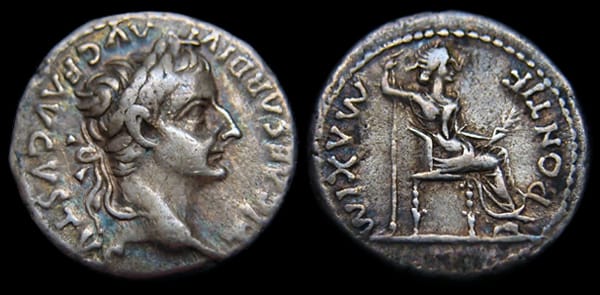
Since Jesus is the Son of God and the true High Priest this seemed to be a conflict of interests. The Herodians were Jewish appeasers to the Roman authority and were testing Jesus to see if he would challenge Caesar. His reply to render unto Caesar what is Caesar’s seemed to satisfy them as they saw it as Jesus supporting their political position. They missed the spiritual implication that God wrote His law on their hearts making them His people (Jer 31:33).
Archaeological Evidence for Rulers in the Bible
New Testament coins minted by Herod the Great, Herod Antipas, Pontius Pilate, Agrippa I, Felix, and Festus have been discovered. At one point the existence of Pontius Pilate was heavily doubted by liberal scholars, but an inscription bearing his name but an inscription bearing his name was found at Caesarea Maritima in 1961. It may seem trivial now that his existence has been proven but artifacts confirming these figures are essential to proving the legitimacy and accuracy of biblical authors. Some scholars questioned the accuracy of Luke’s writing due to perceived conflicts with secular records, but it has now been demonstrated that he was very accurate in recording the titles and positions of various public figures. His accuracy compared to the historical record has allowed for better dating of his writings and events within them.
Conclusion: How Numismatics Confirms Biblical History
While Numismatics is a worthy field of study and diving into the meaning of the images on coins is a noble undertaking, one should not fail to simply enjoy the cool art on coins. To get a full appreciation for each coin, one should take in the surface level enjoyment before they proceed to take a deeper look at the coin. Even the simplest of designs such as the anchor representing coins made at Caesarea Maritima from the reign of Claudius can give a sense of awe as one can imagine someone dropping a coin on the shores near the ancient harbor there. This is a stark contrast to the way the Flavian dynasty used the same mint to strike coins immortalizing the capta of Judea (Hamburger, 1970). The politics behind the coin can sometimes make it less enjoyable although informative.
A deeper examination can reveal information that provides the numismatist with binders of data into the history of the people, places, cultures, and composition involved with making each coin. Despite there being a limited number of New Testament coins mentioned in the Bible, the information about the government officials, ancient economies, and theological implications behind the references give the student of God’s Word a deeper understanding of the text. The field of apologetics owes a debt of gratitude to the archaeologists, numismatists, and archaeometallurgists for their contributions to the data they have laid out confirming the biblical content that skeptics cannot refute.
Bibliography and Further Reading
- Bower, Nathan W., David B. Hendin, and Stephen E. Burt. “An XRD, XRF and Metallographic Study of Ancient Minting Methods Paper #230-7P”, American Chemical Society Division of Analytical Chemistry, Pittcon, Chicago, IL. March 5-9, 2017.
https://www.academia.edu/31893540/An_XRD_XRF_and_Metallographic_Study_of_Ancient_Minting_Methods?auto=download - Burnett, Andrew. “The Early Coinage of Hadrian and the Deified Trajan at Rome and Alexandria.” American Journal of Numismatics (1989-) 20 (2008): 459–77. http://www.jstor.org/stable/43580323
- Butcher, Kevin, and Matthew Ponting. “The Beginning of the End? The Denarius in the Second Century.” The Numismatic Chronicle (1966-) 172 (2012): 63–83. http://www.jstor.org/stable/42678930.
- Carradice, I., and M. Cowell. “The Minting of Roman Imperial Bronze Coins for Circulation in the East: Vespasian to Trajan.” The Numismatic Chronicle (1966-) 147 (1987): 26–50. http://www.jstor.org/stable/42667496
- Cope, Lawrence H. “The Metallurgical Development of the Roman Imperial Coinage During the First Five Centuries A.D.” PhD diss. Liverpool Polytechnic, 1974.
- Edited by David A. Fiensy and Ralph K. Hawkins. The Galilean Economy in the Time of Jesus. United States: SBL Press, 2013.
- Hamburger, H. “The Coin Issues of the Roman Administration from the Mint of Caesarea Maritima.” Israel Exploration Journal 20, no. 1/2 (1970): 81–91. http://www.jstor.org/stable/27925214
- Hendin, David. Guide to Biblical Coins. United Kingdom: American Numismatic Society, 2022.
- Luce, T. J. “Political Propaganda on Roman Republican Coins: Circa 92-82 B. C.” American Journal of Archaeology 72, no. 1 (1968): 25–39. https://doi.org/10.2307/501820.
- Mattingly, H. “Some Historical Roman Coins of the First Century A.D.” The Journal of Roman Studies 10 (1920): 37–41. https://doi.org/10.2307/295786.
- Middelkoop, Willem. “The History of Money.” In The Big Reset: War on Gold and the Financial Endgame, 13–47. Amsterdam University Press, 2016. https://doi.org/10.2307/j.ctt195sdt8.5.
- Rowan, Clare. “Ambiguity, Iconology and Entangled Objects on Coinage of the Republican World.” The Journal of Roman Studies 106 (2016): 21–57. http://www.jstor.org/stable/26346749.
- Savage, Carl E. 2007. Et-tell (Bethsaida): A study of the first century CE in the galilee. PhD. diss, Drew University, 2007.
- Sear, David R.. Roman Coins and Their Values: 4th Edition. United Kingdom: Seaby, 2004.
- Stevens, Susan T. “Charon’s Obol and Other Coins in Ancient Funerary Practice.” Phoenix 45, no. 3 (1991): 215–29. https://doi.org/10.2307/1088792.
- Strong, James. Strong’s Exhaustive Concordance of the Bible. Nashville, TN: Thomas Nelson, 2009.
- Stroobants, Fran. “How Do We Document Ancient Coinage?” In Documenting Ancient Sagalassos: A Guide to Archaeological Methods and Concepts, edited by Jeroen Poblome, 97–122. Leuven University Press, 2023. https://doi.org/10.2307/jj.4145187.7.
- Sutherland, C. H. V. “The Intelligibility of Roman Imperial Coin Types.” The Journal of Roman Studies 49 (1959): 46–55. https://doi.org/10.2307/297622.
- Sydenham, Edward Allen. The Coinage of the Roman Republic. London, UK: Spink, 1952.
- Syon, Danny. “Tyre and Gamla: A Study in the Monetary Influence of Southern Phoenicia on Galilee and the Golan in the Hellenistic and Roman Periods”, PhD diss. Hebrew Univ. 2004.
- West, Louis C. “Imperial Publicity on Coins of the Roman Emperors.” The Classical Journal 45, no. 1 (1949): 19–26. http://www.jstor.org/stable/3293297.